When you replace a split system air conditioner, the two units and the pipes come new. The wall spot, the hole and the power circuit can often stay.
Most of it comes new, and the wall stays useful
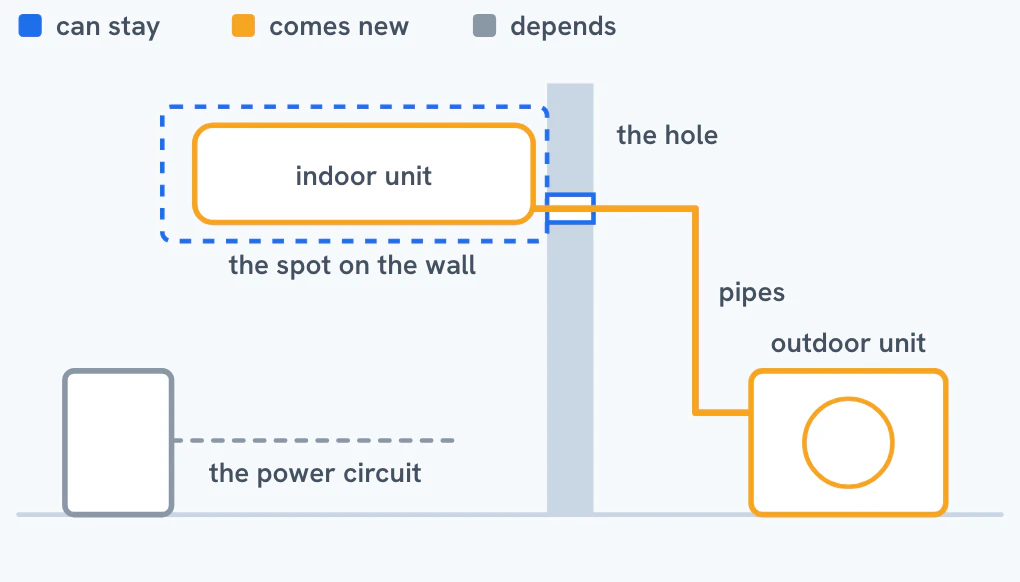
When you replace a split system air conditioner, nearly everything you can see goes. The indoor unit, the outdoor unit, the remote and the pipes between them all come new.
What can carry over is the work already done on your house: the spot on the wall, the hole through it and the power circuit, if it is big enough for the new unit.
| Part | Usually | Why |
|---|---|---|
| Indoor unit | new | it is the system |
| Outdoor unit | new | it is the other half of the system |
| Refrigerant pipes | new | we replace them on every job |
| Spot on the wall | kept | if the new unit fits there |
| Hole through the wall | kept | if it lines up with the new unit |
| Power circuit | depends | on the breaker the new unit asks for |
The pipes: new, every time
Keeping the old pipes sounds like an easy saving, and some manufacturers do allow it under conditions. Mitsubishi Electric's split brochure describes a pipe re-use technology that "may reduce the installation costs", and tells you to ask a dealer for details. Its ducted brochure lists it on the SUZ-M, PUZ-ZM and PUZ-M outdoor units.
The conditions are the catch. Toshiba's installation manual runs the old pipes through a check before they can stay: look for scratches and dents, run the old system on cool for about 30 minutes, recover the gas, then flush the pipes with nitrogen. If badly discoloured oil or a lot of residue comes out, its answer is "Clean the pipes or use new pipes".
So you can't know the old pipes pass until the old system has been taken apart. When we replace a split, we run new pipes every time.
Even a kept pipe needs new ends. Daikin's manual says "Do NOT re-use flares", and it asks for the flare nuts that come with the unit. Toshiba says the same about the old nut.
New gas, and sometimes a bigger pipe
The gas in the system may change too. In our catalogue, 99% of the split models are registered on R32, and none is on R410A or R22. The other 1% has no registration record. So an older unit on R410A or R22 gets replaced by a unit on a different gas.
The size of the pipe can change as well. On Mitsubishi Electric's MSZ-AP range, the liquid pipe stays at 6.35 mm, but the gas pipe goes from 9.52 mm at 4.2 kW to 12.70 mm at 5 kW.
So if your old 3.5 kW unit struggled and you are moving up, the old gas pipe may be the wrong size as well. Our room size guide shows what each room needs.
The spot on the wall and the hole through it
If the old unit sat in a good place, the new one usually can too. Moving the unit means a new hole, new patching and a new run to the outside, so staying put saves work.
The hole has to suit the new unit. Daikin's manual asks for a 65 mm hole on its ATXD wall units, sloping down towards the outside so water runs away. Its mounting plate marks where the pipe hole should sit.
If the old hole misses that mark on your new unit, it gets patched and a new one is drilled.
Check the size of the unit too. Mitsubishi Electric's MSZ-LN is 890 mm wide and its MSZ-EF is 885 mm, so two units of the same rating are close, but your old one may be a very different shape.
The power circuit: fine, if it is big enough
A new unit can use the old circuit only if that circuit suits what the new unit asks for. The brochure gives this as a breaker size, and it grows with the system.
| Mitsubishi Electric MSZ-AP size | Breaker size |
|---|---|
| 2.0 to 4.2 kW | 10 A |
| 5.0 and 6.0 kW | 16 A |
| 7.1 and 7.8 kW | 20 A |
So a move from 3.5 to 7.1 kW can mean a new circuit, even when the pipe and the wall stay simple. Other brands differ: LG lists 16 A on several of its splits, so we go by the new unit's own figure.
Checking the circuit is a job for a licensed electrician. Our phase guide covers the bigger systems that need more than a home's single phase.
What happens to the old unit
The old gas can't just be let go. It has to be recovered before the old system comes out, and on our jobs that's done under our ARC licence, as part of air conditioning replacement.
If you are not sure replacing is the right call yet, our repairs page sets out when a repair is worth it and when it isn't.
Sources
- Mitsubishi Electric Split Systems brochure 2025: pipe re-use technology, MSZ-AP breaker sizes and pipe diameters, MSZ-LN and MSZ-EF dimensions
- Mitsubishi Electric Ducted brochure 2025: the outdoor units that carry pipe re-use
- Daikin ATXD-A installation manual: flares, flare nuts, the 65 mm hole, the mounting plate
- Toshiba RAV-GM1101ATP-E installation manual: the check for existing pipes
- LG DUALCOOL with AI Air brochure: circuit breaker sizes
- Our catalogue under split systems, 31 October 2026: refrigerant from each model's GEMS registration
- Our supply and install page: decommissioning and gas recovery