
They aren't two choices. Reverse cycle is what an air conditioner does and split is how it's built, so most splits are both. Here's how to check yours heats.
Reverse cycle vs split system: what's the difference?
You'll often hear people ask whether they should get reverse cycle or a split system. It sounds like a choice between two things, but it isn't.
Reverse cycle is what an air conditioner does: it cools and it heats. A split system is how it's built: one unit inside and one outside. So one air conditioner can be both, and most split systems are.
Two words, two different questions
Each word answers its own question, and each has its own opposite.
| Word | What it tells you | The other option |
|---|---|---|
| Reverse cycle | what it does | cooling only |
| Split system | how it's built | ducted, window or portable |
So the real questions are: do you want heating from it, and how should it be built for your home?
What does reverse cycle mean?
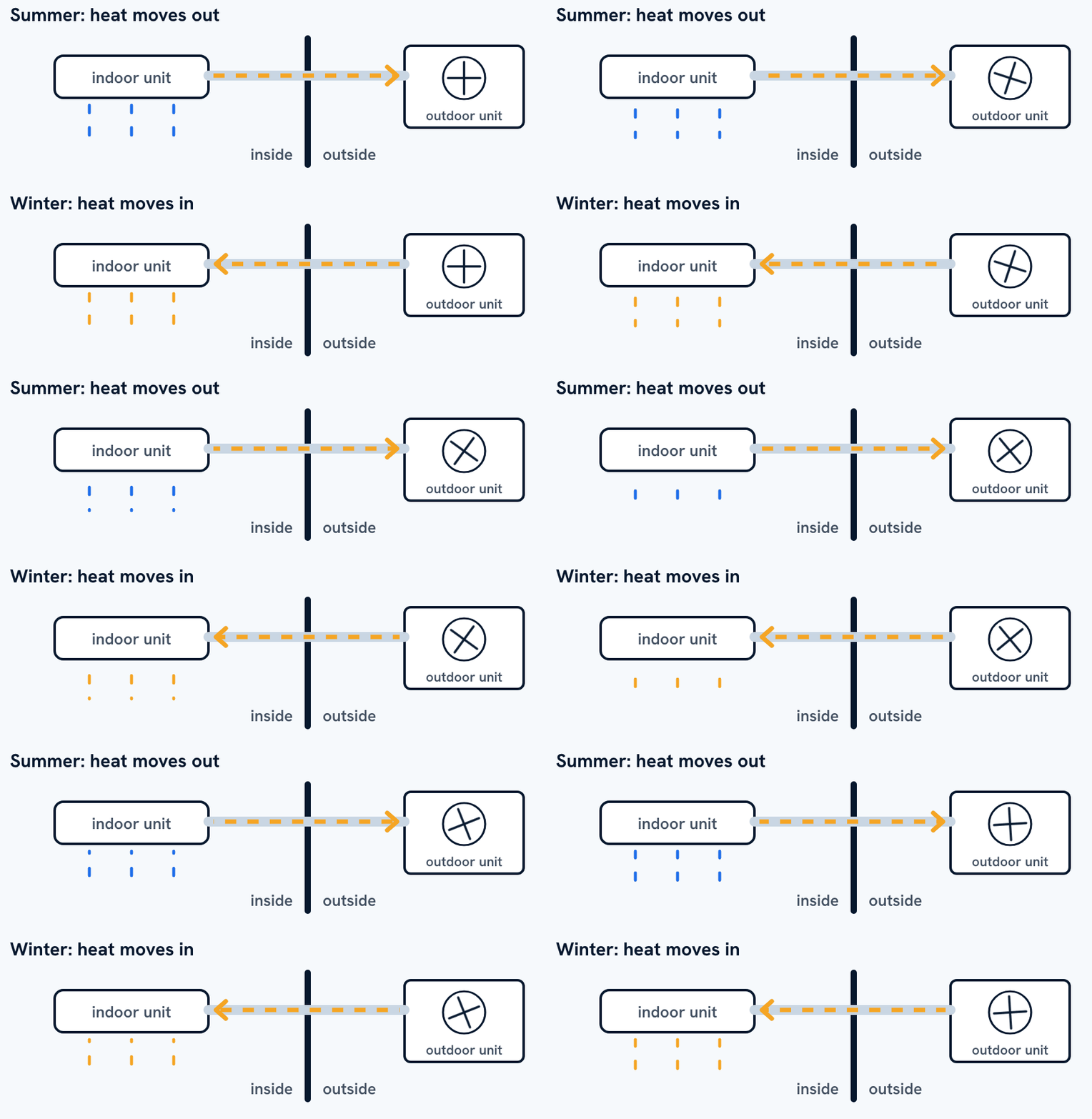
It means one air conditioner does both jobs. The NSW Government calls it an all-in-one heating and cooling solution.
The name tells you how it works. In summer, it moves heat from inside your home to the outside. In winter, it reverses that and pulls warmth in from outside, even when it's cold out.
Mitsubishi Electric's split systems brochure says the same thing another way: one system cools your house in summer and warms it up in winter.
What is a split system?
A split system has one indoor unit and one outdoor unit. That's the split.
Mitsubishi Heavy Industries' split systems brochure puts the indoor unit on a wall inside or in your ceiling, and the outdoor unit on a wall outside.
The NSW Government says split systems are good for individual rooms. For several rooms, a multi-split runs more than one indoor unit from a single outdoor unit.
Is every split system reverse cycle?
No, but most are. Some split systems only cool, and that's why the two words get mixed up.
The government's energy rating register records each air conditioner as reverse cycle or cooling only. Here's how that falls for each way of building one.
| How it's built | Reverse cycle | Cooling only |
|---|---|---|
| Wall split | 91% | 9% |
| Ducted | 93% | 7% |
| Ceiling cassette | 100% | 0% |
| Floor unit | 100% | 0% |
| Window or through-wall unit | 53% | 47% |
| Portable | 21% | 79% |
Those are shares of the approved registrations on 1 November 2026. One model can have more than one registration, so read them as a rough guide.
So you're most likely to meet cooling only on a portable or a window unit. It's less common on a split, but it's there.
How to check a unit heats as well as cools
Don't go by the word "split" on a quote. Two units can share a name and a cooling size, and only one of them heats. Here are two pairs from the Mitsubishi Heavy Industries brochure.
| Unit | Cooling | Heating |
|---|---|---|
| Avanti 2.5 kW | 2.5 kW | 3.2 kW |
| Avanti 2.5 kW (Cool Only) | 2.5 kW | N/A |
| Bronte 7.1 kW | 7.1 kW | 8.0 kW |
| Bronte 7.1 kW (Cool Only) | 7.1 kW | N/A |
So look for a heating figure on the spec sheet, then ask for the quote to say reverse cycle next to the model number.
Every wall split on our site with a government energy record is reverse cycle.
Which one should you ask for?
Start with heating. If you want one system for summer and winter, you're after reverse cycle. Our guide to what reverse cycle heating costs in Sydney shows what that winter side adds up to.
Then pick how it's built, going by what you want to cool and heat:
- One room: a split system.
- Several rooms: a multi-split, where ducted may not be practical.
- The whole home: ducted.
There's more on each in our guide to the types of air conditioners.
Not sure what suits your place? Send a few photos through our quote form and we'll tell you what your home can take. Sometimes that takes a visit.
Sources
- NSW Government, Reverse-cycle air conditioners: what reverse cycle means, summer and winter, what split, multi-split and ducted systems are good for
- Mitsubishi Electric split systems brochure 2025: one system for summer and winter
- Mitsubishi Heavy Industries split systems brochure: where the two units go, the Avanti and Bronte figures
- GEMS registered air conditioners dataset (E3 program), data.gov.au: reverse cycle and cooling only shares, file of 1 November 2026