The Australian Government, NSW and Daikin give three different ranges. Here is what each one says, and what one degree costs you in Sydney.
The short answer
In summer, set your air con between 24 and 26°C, the range the NSW Government gives. In winter, set it to 20°C, the only setting inside both winter ranges below.
The Australian Government, the NSW Government and Daikin each give a range, and the ranges don't match. Here's what each one says, what a degree costs you in Sydney, and how to stay comfortable at the warmer end.
Three sources, three answers
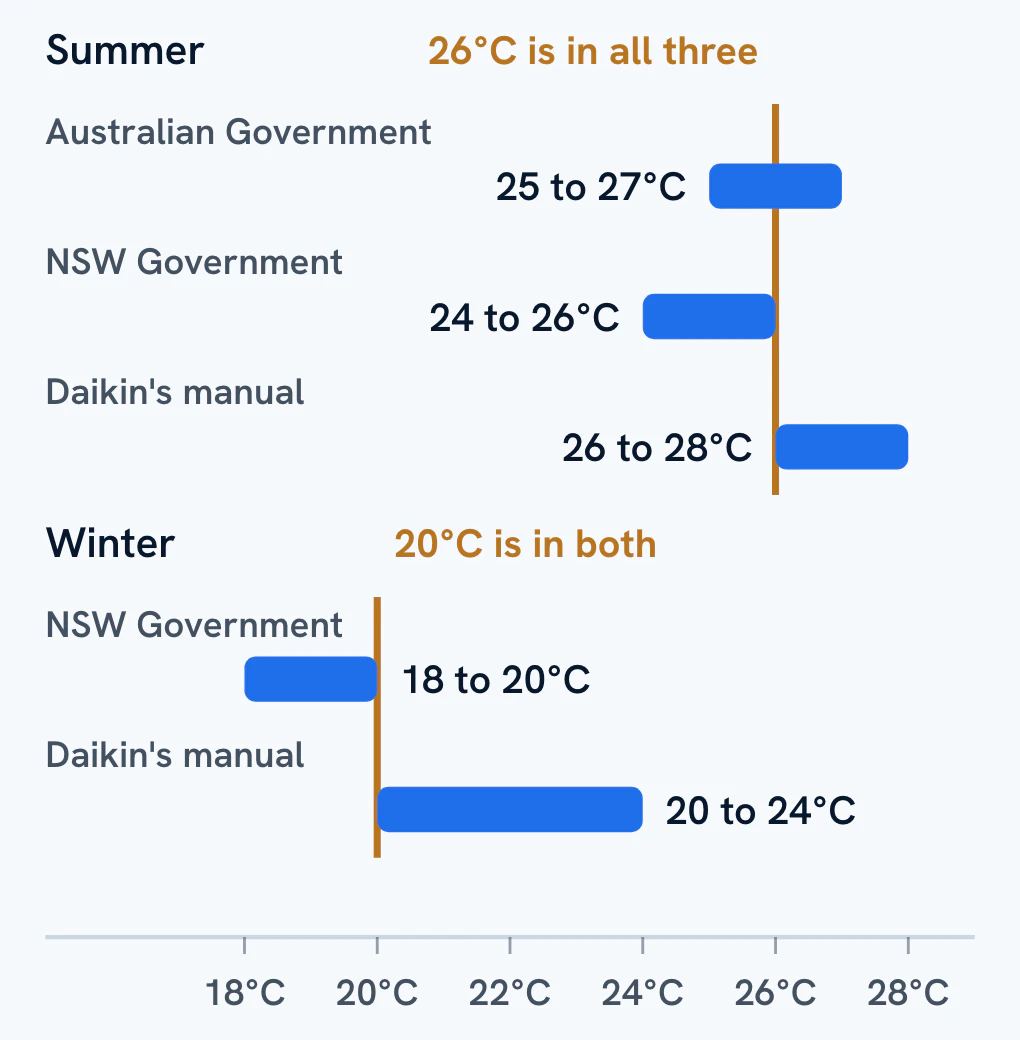
Each source gives a range, not one number:
| Source | Summer | Winter | What one degree saves |
|---|---|---|---|
| Australian Government | 25 to 27°C | not given | 5 to 10% of your energy costs |
| NSW Government | 24 to 26°C | 18 to 20°C | 10% of your heating and cooling costs |
| Daikin's Cora manual | 26 to 28°C | 20 to 24°C | not given |
None of them says why its range is different. The two governments agree on the saving: every degree warmer in summer cuts your costs, and NSW says the same for every degree cooler in winter. Daikin's manual says a moderate setting saves energy.
What one degree costs you in Sydney
Every energy label gives the energy a unit uses over a whole cooling season and a whole heating season. For Sydney's climate zone, the government works it out on the weather in Richmond, NSW. We've priced it at 31.79 cents a kWh, GST included.
Here's the typical split system at each size: the middle of the units we install at that size.
| Size | A summer | One degree in summer | A winter | One degree in winter |
|---|---|---|---|---|
| 2.5 kW | $54 | $3 to $5 | $113 | $11 |
| 3.5 kW | $81 | $4 to $8 | $144 | $14 |
| 5 kW | $128 | $6 to $13 | $231 | $23 |
| 7 kW | $188 | $9 to $19 | $324 | $32 |
| 8 kW | $222 | $11 to $22 | $366 | $37 |
Summer uses the Australian Government's 5 to 10% a degree. Winter uses NSW's 10%, because the Australian Government's summer page doesn't cover heating.
So at 7 kW, setting 24°C instead of 26°C adds about $19 to $38 over a summer.
At every size, a degree in winter costs more than a degree in summer. On the label, a Sydney winter takes more energy than a Sydney summer. Our guide to heating costs in a Sydney winter has the winter side.
At night
Two of the manuals suggest a different setting while you sleep.
Mitsubishi Electric's MSZ‑AP manual gives a low energy setting for a room nobody's in, or while you're asleep: 2 to 3°C warmer when cooling, and 2 to 3°C cooler when heating.
Daikin's Cora manual does it for you. Set the off timer and it moves the setting 0.5°C up when cooling, or 2°C down when heating, so the room doesn't get too cold or too warm while you sleep.
Choosing a unit for the bedroom? Our small split system for a bedroom guide compares noise and running costs.
Staying cool at the warmer end
A few things from the same sources make a warmer setting feel cooler:
- Use a fan. A fan only cools you when it's blowing on you. A portable one costs about 2 to 3 cents an hour to run, the Australian Government says.
- Keep the air moving. Mitsubishi Electric's manual says swinging air feels cooler than still air. Its Econo Cool setting swings the airflow and changes the setting for you to save energy.
- Close the doors to rooms you're not using, so you only cool the ones you need.
- Close the curtains and blinds in the hottest part of the day. Daikin says blocking the sun makes the cooling work better.
- Keep the filters clean. Daikin's manual says a clogged filter wastes energy, and to clean it about every 2 weeks.
If it can't get the room down to the setting on a hot day, our guide to an air conditioner not cooling has checks to try before you call.
Sources
- Australian Government, energy.gov.au: Summer energy savings: 25 to 27°C, 5 to 10% a degree, fans at 2 to 3 cents an hour, closing doors, curtains and blinds. Read 13 November 2026.
- NSW Government, energy.nsw.gov.au: Reverse-cycle air conditioners: 24 to 26°C in summer, 18 to 20°C in winter, 10% a degree. Read 13 November 2026.
- Daikin Cora operation manual, FTXV20 to 71AVMA: 26 to 28°C for cooling and 20 to 24°C for heating, blinds, and filters about every 2 weeks (page 16); the night setting with the off timer (page 26).
- Mitsubishi Electric MSZ‑AP operating manual: the low energy setting and Econo Cool (page 9).
- GEMS registered air conditioners dataset (E3 program), data.gov.au, CC BY 3.0: each unit's cooling and heating season energy for the mixed climate zone, which the data dictionary bases on Richmond, NSW.
- Energy Made Easy, the AER's plan data: the median usage rate across 170 Ausgrid plans, September 2026, with GST added: 31.79 cents a kWh.
- Our split catalogue on 13 November 2026: 105 models at the five sizes, 104 of them with label figures.